
 Deals Of The Day
 Top Sellers
 Top Trending
 New Arrivals
 Shop By Brands
Lifts / Lifting Equipment Stacker
Shop industrial stackers and pallet stackers at Janeice Products Co Inc, your trusted material handling supply source based in Aiken, South Carolina. Whether you need electric self-propelled stackers for warehouse operations, pallet stackers for lifting and positioning loads, or compact material handling equipment for production areas, our catalog offers practical solutions for moving and stacking palletized goods. Designed for warehouses, distribution centers, manufacturing facilities, and industrial workplaces, our stackers help improve material handling efficiency, make better use of vertical storage space, and reduce the physical effort involved in lifting and positioning loads. Explore different lifting capacities, fork configurations, and mast heights to find the right stacker for your operational requirements.
How to Choose the Right Industrial Stacker
Choosing the right industrial stacker for your facility starts with understanding the weight of the loads you handle, the maximum lifting height required, and the type of pallets you use. Consider your daily material handling volume, available aisle space, floor conditions, and the distance loads need to travel. Selecting a stacker that matches your workflow can improve productivity and help make pallet handling more efficient.
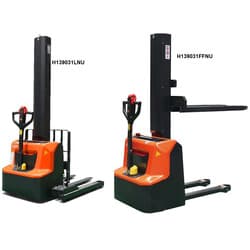
For frequent pallet movement and repetitive lifting tasks, electric stackers can reduce manual effort and support more consistent handling operations. Electric self-propelled stackers, such as the Ballypal models available from Janeice Products, offer battery-powered operation, adjustable forks, and lifting capacities that vary by model. Some models provide lifting heights of up to 157 inches, depending on the selected configuration. Always verify the specifications of the individual model before purchasing.
The operating environment is another important consideration. Compact stackers may be suitable for smaller storage areas and narrow working spaces, while facilities handling heavier pallets may require higher-capacity equipment and appropriate fork configurations. Check the overall width and length of the stacker to ensure it can move safely through your aisles, doorways, and loading areas.
Before ordering, confirm the stacker's rated load capacity, maximum lift height, fork length and width, battery specifications, and overall dimensions. The load's weight distribution and load center are also important when determining whether a particular model is suitable for your application.
Key Features to Look for in Industrial Stackers
-
Load Capacity: Choose a stacker with a rated capacity suitable for your heaviest loads. Janeice Products lists electric stacker models with different capacities, including options rated for 2,200 to 3,500 lbs.
-
Maximum Lift Height: Select a mast height that allows you to reach your required pallet storage levels while maintaining safe operating clearances.
-
Power Type: Manual stackers may suit occasional lifting tasks, while electric models can help reduce physical effort during frequent lifting and material handling operations.
-
Fork Dimensions: Check fork length, width, and adjustability to ensure compatibility with your pallets and the loads being handled.
-
Overall Dimensions: Measure warehouse aisles, doorways, turning areas, and loading spaces to confirm that the equipment can maneuver safely.
-
Battery and Charging: For electric stackers, consider battery voltage, expected operating time, charging requirements, and whether a built-in charger is included.
-
Stability and Safety: Follow the manufacturer's load-capacity chart and operating instructions. Use equipment only on suitable surfaces and never exceed its rated capacity.
-
Maintenance Requirements: Review battery maintenance, inspection schedules, service availability, and replacement-part requirements to support long-term equipment performance.
Industries That Use Industrial Stackers
-
Warehousing & Distribution: Lift, move, and stack palletized inventory in storage areas, picking zones, and dispatch departments.
-
Manufacturing: Transport raw materials, production supplies, and finished goods between workstations and storage locations.
-
Logistics & 3PL: Support pallet handling, order staging, loading preparation, and inventory movement in distribution facilities.
-
Retail & Wholesale: Move palletized merchandise and replenish stock in back-room storage and distribution areas.
-
Automotive & Industrial Parts: Handle pallets of spare parts, components, and packaged materials in manufacturing and service facilities.
-
Food & Beverage: Move packaged goods and palletized supplies in suitable warehouse and distribution environments.
-
Packaging & Assembly: Position materials, packaging supplies, and finished products for production and dispatch operations.
-
Maintenance & MRO: Move replacement parts, equipment supplies, and palletized maintenance materials within industrial facilities.
Frequently Asked Questions About Industrial Stackers
Q1: What is an industrial stacker used for?
An industrial stacker is material handling equipment designed to lift, move, and stack palletized loads. It is commonly used in warehouses, manufacturing facilities, and distribution centers to position goods at different heights and improve the use of available storage space.
Q2: What is the difference between a pallet stacker and a forklift?
A pallet stacker is generally designed for lifting and stacking loads over shorter distances, often in warehouse storage and production areas. A forklift is typically more versatile for demanding material handling operations and may offer greater lifting capacity and travel capability. The appropriate choice depends on load requirements, lift height, aisle dimensions, operating conditions, and the manufacturer's specifications.
Q3: What load capacities are available for electric stackers?
Capacity varies by model and configuration. For example, Janeice Products lists Ballypal electric self-propelled stackers with capacities ranging from 2,200 to 3,500 lbs. Always confirm the rated capacity of the specific model and account for load center, load dimensions, and lifting height before selecting equipment.
Q4: How high can an industrial stacker lift a pallet?
Maximum lifting height depends on the stacker model and mast configuration. Certain Ballypal stackers listed by Janeice Products offer maximum lift heights of up to 157 inches. Check the individual product specifications to confirm the usable lifting height for your intended application.
Q5: Are electric stackers suitable for warehouse operations?
Yes. Electric stackers can be suitable for warehouse operations involving repetitive pallet lifting, stacking, and short-distance movement. Battery-powered operation helps reduce manual effort, while compact configurations may suit certain storage environments. Evaluate aisle width, floor conditions, operating duration, load capacity, and charging requirements before choosing a model.
Q6: How do I choose the right fork dimensions for my pallets?
Check your pallet's entry openings, overall dimensions, load width, and weight distribution. The fork length and width must be compatible with the pallet and load. Adjustable forks can provide additional flexibility for handling different pallet sizes, provided the selected configuration is approved by the manufacturer.
Q7: What safety precautions should I follow when using a stacker?
Inspect the equipment before use, verify the load weight, follow the rated capacity and load-center requirements, and ensure the travel path is clear. Keep loads stable and within the manufacturer's specified limits, avoid operating on unsuitable slopes or surfaces, and never allow people to stand beneath raised loads. Operators should receive appropriate training and follow all manufacturer instructions and applicable workplace safety requirements.
Q8: Where can I purchase industrial stackers for my business?
Janeice Products Co Inc offers industrial material handling equipment for businesses across the United States. Browse the Stackers category to compare available models, capacities, lifting heights, and specifications. For assistance selecting equipment for your facility, contact Janeice Products at +1 803-652-3025 or request a quote through the website.