
 Deals Of The Day
 Top Sellers
 Top Trending
 New Arrivals
 Shop By Brands
Dock Equipment Trailer Jacks
How to Choose the Right Trailer Jacks
Choosing the right trailer jack starts with understanding your trailer's weight, support requirements, and intended application. Consider the maximum loaded trailer weight, required lifting height, static load capacity, and the type of surface where the jack will be positioned. Selecting equipment with the appropriate capacity and adjustment range is essential for maintaining proper trailer support during loading, unloading, and storage operations.
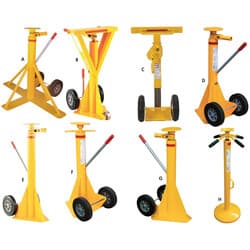
For loading docks and distribution centers, trailer stabilizing jacks are commonly used to support the front end of parked trailers when they are disconnected from tractors. Ratchet-operated and screw-type jacks provide manual height adjustment, while wheeled models make positioning and handling easier around loading areas. Heavy-duty models are suitable for demanding industrial applications when their rated capacities match the required loads.
The base design is another important consideration. A wider support base can help distribute the load over a larger surface area, particularly when trailers are parked on suitable but less-than-ideal ground conditions. Always evaluate the manufacturer's specifications for ground conditions, support capacity, and operating height before selecting a model.
It is also important to understand the difference between lifting capacity and static support capacity. These ratings are not interchangeable. Choose a trailer jack based on its intended application and follow the manufacturer's operating instructions. Trailer stabilizing jacks should not replace approved trailer restraints, wheel chocks, or other required loading dock safety equipment.
Key Features to Look for in Trailer Jacks
-
Load Capacity: Check the rated static support and lifting capacities to ensure the jack is suitable for your trailer and intended application.
-
Height Adjustment: Select a jack with an appropriate minimum and maximum operating height for your trailer requirements.
-
Construction Material: Look for heavy-duty steel construction designed to withstand demanding industrial and outdoor working conditions.
-
Base Design: Consider a wide and stable base that helps distribute loads over the supporting surface.
-
Operating Mechanism: Choose between screw-type, ratchet-operated, or other available mechanisms based on your operational requirements.
-
Wheel Design: Wheeled models can make positioning and transportation easier around loading docks and trailer yards.
-
Durability: Evaluate the frame, adjustment mechanism, support plate, and finish for long-term industrial use.
-
Safety Features: Check locking mechanisms, operating instructions, and compatibility with your facility's trailer restraint and wheel chock procedures.
Industries That Use Trailer Jacks
-
Warehousing & Distribution: Supporting disconnected trailers during loading, unloading, and dock operations.
-
Transportation & Logistics: Stabilizing parked trailers in fleet yards and transportation facilities.
-
Manufacturing: Supporting trailer operations at industrial shipping and receiving departments.
-
Freight & Shipping: Providing additional trailer support in freight terminals and loading areas.
-
Automotive & Trucking: Supporting trailer maintenance and designated service operations with appropriately rated equipment.
-
Construction & Industrial Facilities: Supporting compatible trailers during parking and operational activities.
-
Loading Dock Operations: Helping prevent trailer tipping and providing additional support during forklift loading and unloading activities.
Frequently Asked Questions About Trailer Jacks
Q1: What is the main purpose of a trailer stabilizing jack?
A trailer stabilizing jack provides additional support to a parked trailer when it is disconnected from the tractor. It helps reduce the risk of the trailer tipping forward during loading and unloading operations, particularly when forklifts enter the trailer. It is commonly used in warehouses, distribution centers, and industrial loading docks.
Q2: What is the difference between a trailer jack and a trailer stabilizing jack?
A standard trailer jack is generally used to raise, lower, or support a trailer tongue or hitch when connecting and disconnecting it from a towing vehicle. A trailer stabilizing jack is specifically designed to provide additional support to disconnected trailers, particularly during loading, unloading, and parking operations. Always select equipment according to its intended application.
Q3: How do I determine the correct weight capacity for a trailer jack?
Check the maximum trailer weight, load distribution, support points, and manufacturer's rated static and lifting capacities. Do not assume that the total capacity of multiple jacks can automatically be combined without considering load distribution. Always follow the manufacturer's capacity guidelines and use the equipment within its specified limits.
Q4: Are trailer jacks available with wheels?
Yes, trailer stabilizing jacks are available in wheeled and non-wheeled designs, depending on the model. Wheeled versions make it easier to move and position the equipment around loading docks and trailer yards. Check the individual product specifications for wheel type, dimensions, and mobility features.
Q5: What types of trailer jacks are available for industrial applications?
Common options include screw-operated trailer jacks, ratchet-operated stabilizing jacks, wheeled trailer jacks, and heavy-duty trailer support models. Each type offers different operating mechanisms and support capabilities. The right choice depends on trailer requirements, working conditions, and the manufacturer's specifications.
Q6: Can trailer jacks be used during loading and unloading operations?
Trailer stabilizing jacks are designed to provide additional support to disconnected trailers during appropriate loading and unloading applications. However, they must be used according to manufacturer instructions and alongside the facility's required trailer restraint and wheel chock procedures. Never use a trailer maintenance jack as a substitute for a properly rated trailer stabilizing stand.
Q7: Can I purchase trailer jacks in bulk for my warehouse or distribution center?
Yes, you can contact Janeice Products Co Inc to discuss larger quantity requirements, product availability, and pricing. Our team can help you identify suitable trailer jack options based on your facility's operational needs. Call +1 803-652-3025 or submit a Quote Request through our website for assistance.
Q8: Does Janeice Products ship trailer jacks across the United States?
Janeice Products Co Inc serves customers across the United States from Aiken, South Carolina. Shipping options, costs, and estimated delivery timelines depend on product availability, order quantities, product dimensions, and delivery location. Contact our team at +1 803-652-3025 to confirm shipping details before placing a large order.