
 Deals Of The Day
 Top Sellers
 Top Trending
 New Arrivals
 Shop By Brands
Casters Heavy Duty
Shop heavy duty industrial casters at Janeice Products Co Inc, your trusted material handling supply source based in Aiken, South Carolina. Whether you need heavy-duty swivel casters for maneuverable equipment, rigid casters for straight-line movement, polyurethane wheels for industrial carts, or high-capacity casters for transporting heavy loads, our catalog offers durable mobility solutions for demanding industrial applications. Designed for material handling equipment, platform trucks, manufacturing workstations, warehouse carts, and industrial machinery, heavy-duty casters help businesses move equipment efficiently while supporting reliable performance across a variety of work environments.


How to Choose the Right Heavy Duty Casters
Choosing the right heavy duty casters for your equipment starts with understanding the total load, operating environment, floor conditions, and movement requirements. Consider the combined weight of the equipment and its maximum load, then determine the appropriate load capacity for each caster. When selecting casters for a four-wheel cart, remember that uneven floors and load distribution can cause some wheels to carry more weight than others. Always follow the manufacturer's load-rating guidance and allow an appropriate safety margin.
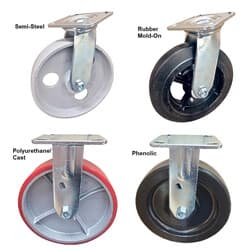
Wheel material is another important factor. Polyurethane wheels are commonly selected for industrial carts because they can provide good wear resistance, floor protection, and relatively quiet operation. Polyolefin and other wheel materials may be suitable for different load and floor conditions. For demanding applications, compare the wheel material, wheel diameter, bearing type, and resistance to oils, moisture, chemicals, and temperature variations.
The caster mounting style also affects equipment performance. Swivel casters allow equipment to turn and maneuver in confined spaces, while rigid casters provide straight-line tracking. A combination of swivel and rigid casters is commonly used on platform trucks and material handling carts to balance maneuverability and directional stability.
Before ordering, verify the mounting plate dimensions, bolt-hole spacing, overall caster height, wheel width, and required ground clearance. Confirm that the selected casters are compatible with your equipment and suitable for the surfaces and operating conditions in your facility.
Key Features to Look for in Heavy Duty Casters
-
Load Capacity: Select casters rated to support the total loaded weight of your equipment. Consider load distribution and operating conditions rather than relying only on the number of wheels.
-
Wheel Material: Choose polyurethane, polyolefin, rubber, or another suitable wheel material based on floor protection, noise, rolling resistance, and environmental requirements.
-
Wheel Diameter: Larger wheels can generally roll more easily over floor joints and minor obstacles, provided the equipment design allows sufficient clearance.
-
Swivel or Rigid Design: Swivel casters improve maneuverability, while rigid casters support straight-line movement. Choose the configuration that best matches your equipment and workflow.
-
Bearing Type: Ball bearings and roller bearings offer different performance characteristics. Check the manufacturer's specifications for load capacity, rolling resistance, and maintenance requirements.
-
Mounting Configuration: Verify top-plate dimensions, bolt-hole spacing, mounting hardware, and caster height to ensure a secure fit.
-
Brakes and Locks: Consider wheel brakes or swivel locks when equipment needs to remain stationary during loading, unloading, or operation.
-
Operating Environment: Evaluate floor conditions, moisture, chemicals, temperature, and exposure to debris before selecting a caster and wheel combination.
Industries That Use Heavy Duty Casters
-
Manufacturing: Move heavy machinery, production carts, workstations, fixtures, and industrial equipment between work areas.
-
Warehousing & Distribution: Support loaded platform trucks, picking carts, material handling equipment, and internal transportation operations.
-
Automotive: Provide mobility for service carts, component handling equipment, maintenance tools, and industrial workstations.
-
Construction & Maintenance: Move heavy equipment, tool carts, repair supplies, and maintenance units across suitable work surfaces.
-
Logistics & Transportation: Improve the movement of loaded platform trucks, distribution carts, and equipment used in shipping and receiving.
-
Industrial Workshops: Support mobile workbenches, assembly stations, tool storage units, and heavy-duty service carts.
-
Commercial & Institutional Facilities: Provide mobility for heavy equipment, utility carts, and storage units where the selected caster capacity and floor conditions are appropriate.
Frequently Asked Questions About Heavy Duty Casters
Q1: What are heavy duty casters used for?
Heavy duty casters are designed to provide mobility for equipment and carts carrying substantial loads. They are commonly used on industrial platform trucks, material handling carts, mobile workstations, machinery, and equipment used in warehouses, manufacturing facilities, and workshops.
Q2: How do I determine the load capacity required for heavy duty casters?
Start by adding the weight of the equipment and the maximum load it will carry. Divide the total weight by the number of casters, then account for uneven load distribution, floor conditions, and the manufacturer's recommended safety margin. Do not select casters based solely on an equal distribution of weight across every wheel.
Q3: What is the difference between swivel and rigid heavy duty casters?
Swivel casters rotate around a vertical axis, allowing equipment to turn and maneuver. Rigid casters travel in a fixed direction and provide better directional tracking. Many industrial carts combine swivel and rigid casters to achieve a practical balance of steering control and stability.
Q4: Which wheel material is best for heavy duty industrial casters?
The best wheel material depends on the load, floor surface, noise requirements, and operating environment. Polyurethane is a common choice for industrial applications because it can offer good wear resistance and floor protection. Other materials may be better suited to particular chemical exposures, temperature ranges, or floor conditions. Always check the product specifications for the intended application.
Q5: What size heavy duty casters should I choose?
The appropriate caster size depends on the load, floor conditions, required rolling performance, mounting height, and available clearance. Larger wheels can help equipment travel over floor joints and minor obstacles, while smaller wheels may fit compact equipment. Confirm the complete caster dimensions and mounting requirements before purchasing.
Q6: Can heavy duty casters be fitted to existing carts and equipment?
Yes, heavy duty casters can often be installed on existing carts and equipment when the mounting configuration and load requirements are compatible. Check the mounting plate, bolt-hole spacing, fasteners, overall height, and structural strength of the equipment frame before replacing existing casters.
Q7: Are heavy duty casters available with brakes?
Some heavy duty caster configurations offer brakes or locking mechanisms to help prevent unintended movement. Availability and brake design vary by model. Review the individual product specifications to confirm whether a wheel brake, swivel lock, or another locking option is available for your application.
Q8: Where can I buy heavy duty industrial casters?
Janeice Products Co Inc offers industrial material handling products, including a dedicated heavy duty caster category. Browse the available options to compare wheel materials, dimensions, mounting styles, and load ratings, and select a configuration suited to your equipment and operating requirements.